A Guide to Navigating Social Media with Your Self-Respect Intact
We have a sticker chart at our house. When my five-year-old daughter helps with a chore, like putting away her toys, she gets to put a shiny, gold star on the chart. She loves it. Her eyes light up, and she feels proud when she sees all the stars lined up in a row.
But I noticed something interesting the other day. After cleaning her room, she ran to me, not saying, “Daddy, look how nice and tidy my room is!” but “Daddy, I get a sticker now!”
The reward—the little gold star—had become more exciting than the accomplishment itself. The external validation (the sticker) was starting to overshadow the internal satisfaction of a job well done.
And in that moment, I saw a perfect, miniature version of the trap that social media sets for all of us. We are all just chasing stickers, and I worry that we are forgetting the real reason we’re doing things in the first place.
The Modern Sticker Chart: How Social media Hijacks Your Brain
A father needs to be direct about this: Instagram, TikTok, and all the rest are designed to work exactly like that sticker chart, but on a massive, global scale.
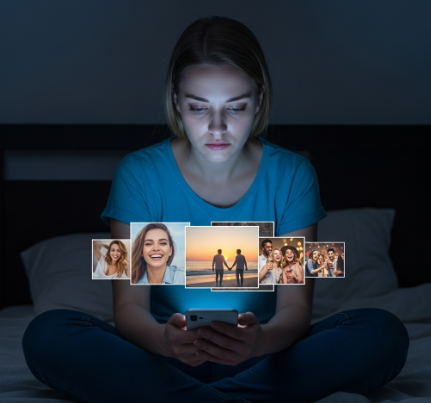
Every “like,” every new follower, every positive comment is a little gold star. Each one gives your brain a tiny hit of a chemical called dopamine, which feels good. Your brain loves this feeling, so it starts to crave more. You post a photo, then you check your phone obsessively, waiting for the validation to roll in. This isn’t a flaw in your character; it’s a feature of the software, designed by very smart people to keep you coming back.
This process slowly and silently rewires your sense of self-worth. You begin to tie your value not to who you are, but to how your performance of “you” is received by an online audience.
This leads to two dangerous traps.
1. The Comparison Trap: You are comparing your real life—with all its messy, complicated, and normal moments—to everyone else’s perfectly curated highlight reel. You see the engagement photos from a friend, but not the argument they had in the car on the way to the proposal. You see the promotion announcement, but not the 80-hour work weeks and crippling anxiety that led to it. It’s a rigged game you will always lose because you are comparing your full, unedited reality to someone else’s advertising campaign for their own life.
2. The Performance Trap: This is the more subtle trap. You start living your life in order to post about it. You go to a beautiful place not just to enjoy the view, but to get the perfect photo of yourself enjoying the view. You order a beautiful meal and let it get cold while you search for the perfect camera angle. Your life starts to feel like a performance for an audience, and you lose the ability to find joy in the simple, un-posted moments. The experience becomes secondary to the documentation of the experience.
A Dad’s Rules for a Healthy Mind Online
This isn’t a lecture to get off social media. It’s a guide to using it wisely, without letting it use you.
- Rule #1: Curate Your Feed Ruthlessly. Your social media feed is the wallpaper of your mind. You wouldn’t stare at a wallpaper that makes you feel anxious or inadequate all day, so why do it with your phone? Unfollow any account, whether it’s an influencer with a “perfect” body or an old acquaintance whose life seems impossibly glamorous, that consistently makes you feel bad about yourself. Fill your feed with things that are truly inspiring, educational, or genuinely funny. Be the strict gatekeeper of what you allow into your mind.
- Rule #2: The Ink is Permanent. Before you post anything—a photo, a comment, a story—I want you to imagine you are writing it in permanent ink in a public square. The internet does not forget. A foolish comment made in anger or a revealing photo posted for a moment of attention can be screenshotted and saved forever. It can be seen by future boyfriends, future employers, and even your future children years from now. Never post anything online that you wouldn’t be comfortable having on a billboard next to your name for the rest of your life. This isn’t about being scared; it’s about being smart and protecting your future self.
- Rule #3: Treat It Like a Magazine, Not a Mirror. This is a crucial mindset shift. You would never look at a fashion magazine and think, “Why doesn’t my real life look like this airbrushed photoshoot?” You understand that it’s a fantasy. Treat social media the same way. It is a collection of carefully selected, edited, and curated highlights. It is not a mirror reflecting reality. It is a magazine designed to keep you turning the pages.
- Rule #4: Set “No-Phone” Boundaries. Designate sacred times and places where the phone is not welcome. The first hour of your day before your mind has been cluttered. The dinner table where real connection happens. During a walk in nature where you can hear your own thoughts. This allows your brain to reset and reconnect with the real, uncurated world, reminding you that life is what happens when you’re not looking at a screen.
- Rule #5: Audit Your “Why.” Before you post a picture, ask yourself a simple, honest question: “Why am I sharing this?” Is it to genuinely connect with people I care about and share a happy moment? Is it to share something I’m proud of creating? Or is it because I feel anxious, bored, or insecure and I need a quick hit of validation from strangers to feel better? Being honest with yourself about your motivation is the first step to freedom from the validation cycle.
The “Dad Mode” Conclusion
The sticker chart in my daughter’s room is a fun game, but I make sure to tell her every day that the reason I’m proud of her is not because of the shiny stars on the wall, but because of the good, kind, and hard-working little person she is.
I’m telling you the same thing.
Your worth is not determined by an algorithm designed to sell ads. It is inherent, unchanging, and absolute. The number of likes you get will never measure the amount of love you deserve. You were worthy long before the internet existed, and your value has nothing to do with how many people double-tapped a photo of your lunch. Don’t you ever forget that.